Python vs JavaScript in 2026: Which Should You Learn First?
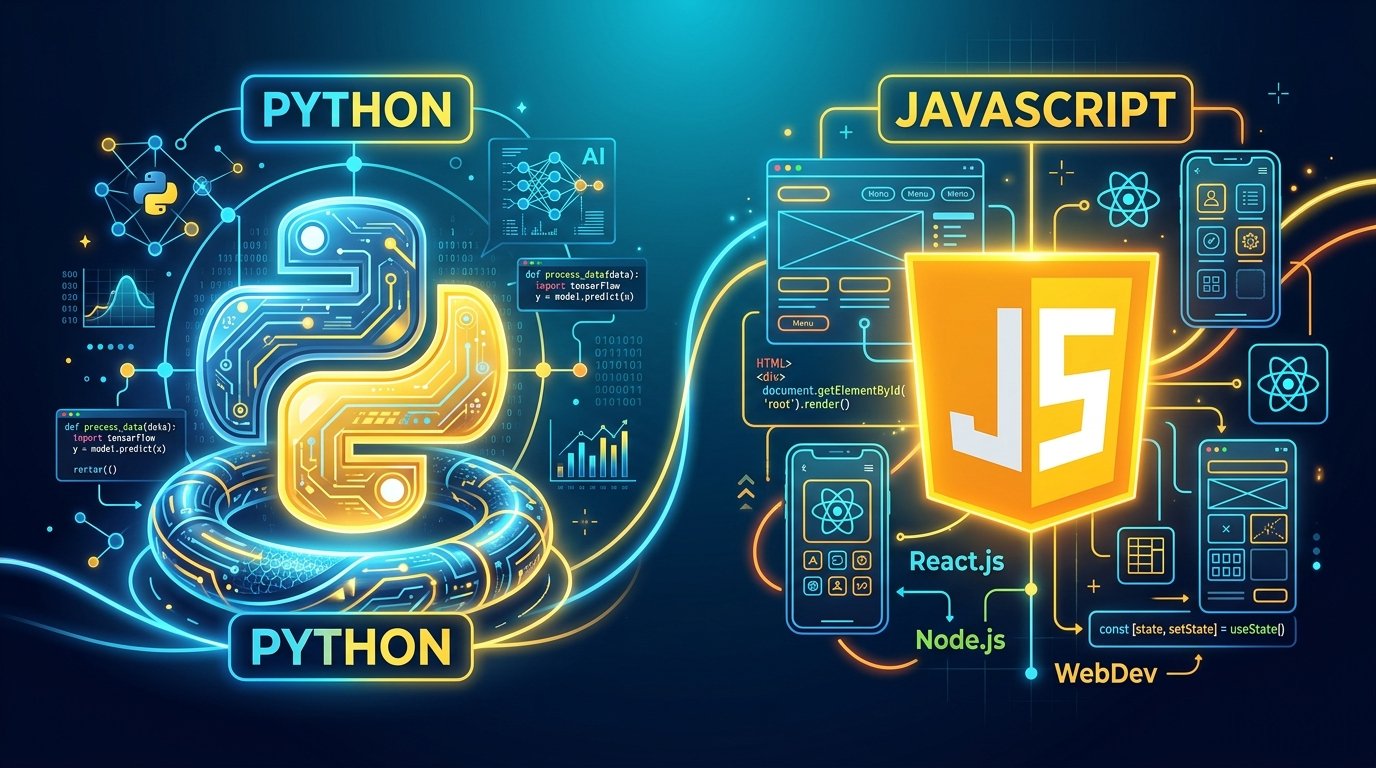
Choosing between Python and JavaScript is one of the most common questions new programmers ask, and for good reason. Both languages are beginner-friendly, both have huge job markets, and both show up constantly in "best programming languages to learn" lists. But they aren't interchangeable, and picking the right one for your goals can save you months of wasted effort.
In this guide, we compare Python vs JavaScript across syntax, real-world use cases, performance, career prospects, and salary potential so you can decide with confidence which language deserves your time first.
Quick answer: Choose Python if you're interested in data science, AI/ML, automation, or backend development. Choose JavaScript if you want to build websites, web apps, or work in front-end/full-stack development. Read on for the full breakdown.
Table of Contents
- What Is Python?
- What Is JavaScript?
- Python vs JavaScript: Syntax Comparison
- Python vs JavaScript: Use Cases
- Python vs JavaScript: Performance
- Python vs JavaScript: Learning Curve
- Python vs JavaScript: Ecosystem and Tools
- Python vs JavaScript: Jobs and Salary
- Which Should You Learn First?
- Frequently Asked Questions
What Is Python?
Python is a high-level, general-purpose programming language created by Guido van Rossum in 1991. It's known for clean, readable syntax that closely resembles plain English, which makes it one of the most beginner-friendly languages available. Python has become the go-to language for data science, machine learning, artificial intelligence, automation, and backend web development.
What Is JavaScript?
JavaScript is the programming language of the web. Created in 1995 by Brendan Eich, it was originally built to add interactivity to websites and runs natively in every web browser. Since the launch of Node.js in 2009, JavaScript can also run on servers, making it a true full-stack language. Today, it powers the front end of virtually every website and is a top choice for web development, mobile apps (via React Native), and full-stack engineering.
Python vs JavaScript: Syntax Comparison
Python's syntax uses indentation instead of curly braces, which keeps code visually clean:
def greet(name):
    if name:
        print(f"Hello, {name}!")
    else:
        print("Hello, stranger!")
JavaScript relies on curly braces and semicolons:
function greet(name) {
  if (name) {
    console.log(`Hello, ${name}!`);
  } else {
    console.log("Hello, stranger!");
  }
}
Takeaway: Python's syntax is generally considered easier to read for beginners. JavaScript has more syntax rules upfront (brackets, semicolons, variable declarations) but becomes intuitive with practice.
Python vs JavaScript: Use Cases
| Use Case | Python | JavaScript |
|---|---|---|
| Data Science & Analytics | ✅ Industry standard | ❌ Rarely used |
| Machine Learning / AI | ✅ Dominant (TensorFlow, PyTorch) | ❌ Limited |
| Web Front-End | ❌ Not applicable | ✅ Only native browser language |
| Web Back-End | ✅ Django, Flask, FastAPI | ✅ Node.js, Express |
| Mobile App Development | ⚠️ Limited (Kivy, BeeWare) | ✅ React Native, Ionic |
| Automation & Scripting | ✅ Excellent | ⚠️ Possible but less common |
| Real-Time Apps (chat, live data) | ⚠️ Possible | ✅ Excellent (event-driven) |
If your goal is web development in any form, JavaScript is essentially mandatory since browsers only execute JavaScript natively. If your goal involves data, AI, or automation, Python is the stronger and more widely supported choice.
Python vs JavaScript: Performance
JavaScript, especially via the V8 engine used in Chrome and Node.js, generally executes faster for everyday tasks and handles concurrent operations well thanks to its asynchronous, event-driven design, ideal for chat apps, live dashboards, and APIs serving many users at once.
Python is slower for raw computation as an interpreted, dynamically typed language. However, its most popular data science and ML libraries (NumPy, TensorFlow, PyTorch) are built on optimized C/C++ code under the hood, so performance-critical work still runs efficiently.
Verdict: JavaScript wins on general speed and concurrency; Python compensates with highly optimized libraries in its core domains.
Python vs JavaScript: Learning Curve
Python is widely recommended as a first programming language because of its:
- Simple, forgiving syntax
- Predictable behavior (fewer quirky type-coercion rules)
- Instant script execution and feedback
- Use in top computer science courses like Harvard's CS50
JavaScript has a steeper initial learning curve since it often requires understanding the browser, the DOM, and asynchronous concepts (callbacks, promises, async/await) early on. That said, seeing a webpage change instantly as you code can be a powerful motivator for beginners.
Python vs JavaScript: Ecosystem and Tools
Python uses pip and the PyPI package index, with a mature, stable ecosystem, especially in scientific computing, where core libraries have led the field for over a decade.
JavaScript uses npm, the largest package registry in the world, with over a million packages available. This offers unmatched flexibility but also faster churn: new frameworks (React, Vue, Svelte, Next.js) and build tools appear regularly, which can feel overwhelming to newcomers.
Python vs JavaScript: Jobs and Salary in 2026
Both languages rank consistently among the most in-demand programming languages globally and in India.
Common Python job titles:
- Data Scientist / Data Analyst
- Machine Learning Engineer
- Backend Developer
- DevOps / Automation Engineer
Common JavaScript job titles:
- Front-End Developer
- Full-Stack Developer (often MERN stack: MongoDB, Express, React, Node.js)
- Mobile App Developer
- Web Application Engineer
In India's job market, Python demand is surging alongside the growth of AI and analytics roles, while JavaScript remains the backbone of the web and product development industry, particularly at startups and IT services firms. Salaries between the two are broadly comparable: your specialization and experience level matter more than the language itself.
Which Should You Learn First? (Decision Guide)
Learn Python first if you want to:
- Break into data science, AI, or machine learning
- Automate repetitive tasks or write scripts
- Learn core programming concepts with minimal syntax friction
- Work in research, academia, or scientific computing
Learn JavaScript first if you want to:
- Build websites or web applications
- Become a front-end or full-stack developer
- Build mobile apps using web-based frameworks
- Get quick, visual feedback from your code
Learn both if you want to:
- Build complete full-stack applications (Python backend + JavaScript frontend)
- Maximize your career flexibility and job opportunities
- Become a well-rounded, versatile developer
Your first language is a starting point, not a permanent choice. Most professional developers know several languages and pick up new ones as projects demand.
Frequently Asked Questions
Is Python or JavaScript better for beginners?
Python is generally considered easier for absolute beginners due to its simple, readable syntax and predictable behavior. JavaScript has a slightly steeper learning curve but offers immediate visual feedback through web pages.
Is Python or JavaScript more in demand in 2026?
Both are consistently top-ranked in developer surveys and job postings. Python leads in data science and AI roles; JavaScript leads in web and full-stack development roles.
Can I learn Python and JavaScript at the same time?
It's possible but not recommended for absolute beginners. It's generally more effective to build a solid foundation in one language before adding a second, as concepts transfer more easily once you're comfortable with the fundamentals.
Which pays more, Python or JavaScript developers?
Salaries are broadly comparable between the two. Pay differences are driven more by specialization (e.g., machine learning engineering vs. general web development), experience, and company than by the language itself.
Do I need JavaScript even if I learn Python?
If you want to build any kind of website or web interface, yes. JavaScript is the only language browsers execute natively, so it's effectively required for front-end work regardless of your other skills.
Conclusion
There's no single "winner" in the Python vs JavaScript debate: the right choice depends on what you want to build. Choose Python for data, AI, automation, and backend work. Choose JavaScript for web development, interactive interfaces, and full-stack products. Whichever you start with, focus on building real projects and problem-solving skills because the language is just the tool.